
SaaS churn in healthcare is defined as the rate at which a healthcare software company loses customers or recurring revenue over a given period, shaped heavily by regulatory compliance demands and deep platform integration requirements that have no parallel in horizontal SaaS markets. Healthcare SaaS churn risk factors include forced EHR migrations, HIPAA audit failures, and contract structures that suppress visible churn for months before a formal cancellation arrives. The average monthly churn rate sits at 1.4%, translating to roughly 15.9% annually. That figure sounds manageable until you factor in that once a healthcare client decides to leave, recovery is nearly impossible.
What drives SaaS churn in healthcare differently than other markets?
Healthcare SaaS churn does not behave like churn in general software markets. The reasons for churn in healthcare SaaS are structural, not just relational, and understanding that distinction changes how you respond.
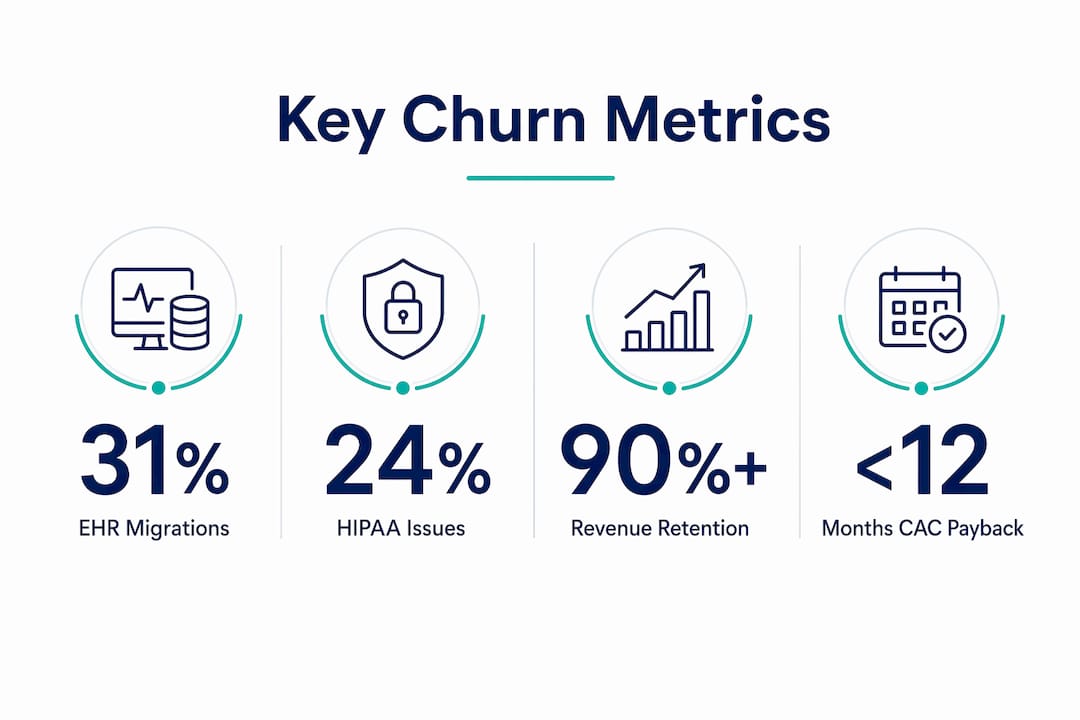
Forced platform migrations from EHR or practice management system switches account for approximately 31% of cancellations. This is the single largest driver of churn in the sector, and it is largely outside the control of your customer success team. When a health system standardizes on a new EHR, every integrated vendor faces displacement risk regardless of satisfaction scores.

HIPAA compliance failures are the second largest driver. Failed audits, gaps in Business Associate Agreements, and inadequate breach response protocols contribute approximately 24% of churn. Poor HIPAA documentation is not just a legal liability. It is an early warning signal that a contract termination is coming.
Budget cuts account for 19% of cancellations, and poor technical support responsiveness drives 8%. These are the factors most healthcare SaaS companies focus on, yet together they represent less than a third of total churn. The real risk sits in compliance and integration, two areas that require product and operational investment, not just better account management.
- EHR migration risk: Build certified integrations with major EHR platforms to reduce displacement risk when clients switch systems.
- HIPAA compliance gaps: Maintain current BAAs, conduct proactive compliance audits, and document breach response protocols before clients ask.
- Budget sensitivity: Offer tiered contract structures that allow clients to scale down rather than cancel outright.
- Support responsiveness: Track time-to-resolution as a leading retention metric, not just a service metric.
Pro Tip: Map every client account to its primary EHR platform. When that EHR announces a major update or acquisition, treat every client on that platform as a retention risk and engage proactively.
How do you measure and benchmark churn in healthcare SaaS?
Churn rate analysis in healthcare requires more than a single cancellation metric. Healthcare contracts are complex, multi-year, and often include usage tiers that make a single logo churn number misleading.
Gross Revenue Retention (GRR) measures the percentage of recurring revenue retained from existing clients, excluding any expansion. Healthy healthcare SaaS companies target GRR between 90% and 94%. A GRR below 90% signals product or compliance problems that no amount of new sales will fix.
Net Revenue Retention (NRR) adds expansion revenue from upsells and cross-sells. Top-performing healthcare SaaS platforms achieve NRR between 108% and 118%, with leading companies exceeding 120%. NRR above 100% means your existing client base grows revenue even without new logos. That is the financial profile that commands premium valuations.
CAC payback period is the third critical metric. The ideal target is under 12 months, but many healthcare SaaS companies see payback periods of 18–30 months due to long sales cycles and high onboarding costs. High churn compresses the window in which you recover acquisition costs, making every lost client disproportionately expensive.
| Metric | Healthy Target | Warning Signal |
|---|---|---|
| Monthly churn rate | 1.0–1.4% | Above 2% |
| Gross Revenue Retention | 90–94% | Below 88% |
| Net Revenue Retention | 108–118% | Below 100% |
| CAC payback period | Under 12 months | Above 24 months |
Beyond these headline metrics, monitor inactive account drift. Clients in healthcare SaaS often remain operationally inactive or disengaged for 12–18 months before formally cancelling. Churn is a lagging metric in this sector. By the time a cancellation notice arrives, the decision was made a year ago.
- Track login frequency, feature adoption rates, and support ticket volume as leading indicators.
- Flag accounts with declining usage 90 days before contract renewal, not 30.
- Use cohort churn analysis to identify which client segments or onboarding cohorts show the highest 12-month attrition.
What strategies reduce churn in healthcare SaaS?
Reducing healthcare SaaS churn requires embedding retention into platform design and operations, not treating it as a customer success afterthought. The most effective interventions combine automation, compliance infrastructure, and unified data systems.
1. Automate personalized retention workflows before billing dates.
Automated cancellation workflows deployed proactively before billing periods reduce churn by approximately 28% and retain up to two-thirds of clients who initiate a cancellation. Personalized outreach triggered 7 days before a billing date, addressing the client’s specific usage patterns and contract terms, outperforms generic renewal campaigns by a wide margin. The key word is personalized. A message referencing a client’s actual workflow adoption rate carries more weight than a standard renewal reminder.
2. Embed retention signals into EHR and practice management workflows.
Clients who use your platform inside their existing clinical workflows are significantly harder to displace. Certified EHR integrations, standardized provisioning, and lifecycle automation that mirrors clinical workflows create operational dependency that survives budget reviews and leadership changes.
3. Deploy proactive HIPAA compliance documentation.
Maintain current BAAs for every active client. Conduct annual compliance reviews and share results with client compliance officers before they ask. Clients who see documented compliance activity are less likely to cite regulatory risk as a reason to switch.
4. Unify billing, support, and implementation data into a single retention view.
Fragmented operational data is one of the most common causes of preventable churn. When your billing team, support team, and implementation team operate in separate systems, at-risk accounts fall through the gaps. A unified platform view that surfaces billing disputes, open support tickets, and stalled onboarding milestones in one dashboard gives your retention team the context to intervene before a client disengages.
5. Assign clinical workflow consultants to high-value accounts.
Clients who receive dedicated clinical workflow support during onboarding show measurably higher long-term retention. This is especially true for accounts integrating with complex EHR environments. A clinical messaging framework that aligns your platform’s value to clinical outcomes gives account teams a language that resonates with both clinical and administrative decision-makers.
Pro Tip: Build a “churn risk score” that combines login frequency, support ticket volume, billing disputes, and days since last EHR sync. Review the top 10% of at-risk accounts in a weekly retention meeting.
What is the real business impact of churn on healthcare SaaS growth?
The impact of churn on healthcare software compounds over time in ways that a single-period churn rate does not capture. High churn does not just reduce revenue. It distorts every growth metric you report to investors and board members.
When CAC payback stretches to 18–30 months and annual churn runs at 15.9%, a meaningful portion of your client base churns before you have recovered the cost of acquiring them. That math makes growth expensive and fragile. Every new logo you add is partially offset by a departing client whose acquisition cost you never recovered.
Churn is not a customer success problem. It is a product and operations problem wearing a customer success disguise. The companies that fix churn at the platform level, through certified integrations, compliance infrastructure, and unified operational data, are the ones that achieve NRR above 110% and sustain it. The ones that treat churn as a relationship issue keep hiring more account managers and wondering why the number does not move.
Low churn, by contrast, creates compounding advantages. Healthcare SaaS customer retention above 90% GRR enables expansion into adjacent clinical workflows, supports upsell of premium modules, and drives NRR above 108%. That profile attracts growth-stage capital and supports higher valuation multiples. Investors in healthcare SaaS use NRR as a proxy for product-market fit and operational health.
Neglecting operational data integration delays churn detection and costs renewal opportunities that are difficult to recover. The clients most likely to expand are also the most likely to churn quietly if their operational experience degrades. Monitoring both expansion signals and disengagement signals from the same data system is the only way to manage both outcomes simultaneously.
Key Takeaways
Healthcare SaaS churn is primarily a structural and compliance problem, not a relationship problem, and fixing it requires platform-level investment in integrations, compliance documentation, and unified operational data.
| Point | Details |
|---|---|
| Churn is structurally driven | EHR migrations (31%) and HIPAA failures (24%) cause more churn than budget cuts or poor support. |
| Use multiple retention metrics | Track GRR (90–94%), NRR (108–118%), and CAC payback together for a complete retention picture. |
| Automate before billing dates | Personalized workflows deployed 7 days before billing reduce churn by approximately 28%. |
| Unify operational data | Fragmented billing, support, and implementation data creates blind spots that accelerate client loss. |
| Churn is a lagging signal | Clients disengage 12–18 months before cancelling; monitor usage and activity as leading indicators. |
Churn is an operations problem, not a relationship problem
I have worked with healthcare SaaS companies that had excellent customer success teams and still churned at rates that undermined their growth. The pattern is consistent. The team is skilled, the relationships are strong, but the platform has gaps. The EHR integration is fragile. The compliance documentation is reactive. The billing, support, and implementation data live in three different systems that no one reconciles until a client is already gone.
What I have found is that the companies that genuinely reduce churn do it by treating retention as a product requirement, not a post-sale activity. They build certified integrations before clients ask. They run proactive compliance reviews and share the results. They build a unified operational view that surfaces at-risk accounts before the account manager gets a cancellation email. The advisory board structure of a healthcare SaaS company should include clinical and compliance voices precisely because churn in this sector is driven by clinical workflow failures and regulatory gaps, not just pricing or support quality.
If your churn rate is not moving despite strong customer success investment, look at your platform architecture and your compliance infrastructure. That is where the answer usually lives.
— Paul
How Thestartupmd helps healthcare SaaS companies retain clients
Healthcare SaaS retention is not a marketing problem or a sales problem in isolation. It sits at the intersection of clinical strategy, compliance operations, and product design.
Thestartupmd works with healthcare SaaS startups and growth-stage companies to align go-to-market strategy with the operational realities of clinical environments. From building a retention-focused services strategy to advising on clinical workflow integration and compliance positioning, the work is grounded in 25 years of clinical and executive experience. If your churn metrics are not moving in the right direction, or if you are preparing for a growth round and need your retention story to hold up under investor scrutiny, a conversation with Paul Bergeron, MD, MBA may be the most direct path forward. Reach out through Thestartupmd to start that conversation.
FAQ
What is the average churn rate for healthcare SaaS?
The average monthly churn rate for healthcare SaaS is 1.4%, which translates to approximately 15.9% annually. This is lower than horizontal SaaS due to high switching costs, but once a client decides to leave, recovery is nearly impossible.
Why do healthcare SaaS customers leave?
The leading reasons for churn in healthcare SaaS are forced EHR platform migrations (31% of cancellations) and HIPAA compliance failures (24%). Budget cuts and poor technical support account for a smaller share of total churn.
What is a good Net Revenue Retention rate for healthcare SaaS?
Healthy healthcare SaaS companies target NRR between 108% and 118%, with top performers exceeding 120%. NRR above 100% means existing clients generate more revenue over time, even without adding new logos.
How early do healthcare SaaS clients disengage before cancelling?
Clients often become operationally inactive or disengaged 12–18 months before formally cancelling a contract. Monitoring login frequency, feature adoption, and support ticket volume provides earlier warning than waiting for a cancellation notice.
How effective is retention automation in reducing healthcare SaaS churn?
Automated retention workflows deployed before billing dates reduce churn by approximately 28% and retain up to two-thirds of clients who initiate a cancellation, making automation one of the highest-return retention investments available.
Recommended
- Healthcare Startup Investor Pitch Checklist for Founders
- Care Model Innovation Explained for Healthcare Startups
- Start Up MD – The Startup MD specializes in elevating small to mid-size healthcare startups by offering a comprehensive suite of services, including an integrated digital marketing strategy with targeted lead generation, engaging content creation (long and short-form videos), and custom website design.