
A medical advisory board is defined as a group of clinical and scientific experts who provide non-binding guidance to help a healthcare startup validate its product, build credibility, and reach the right market. Unlike a board of directors, medical advisors carry no fiduciary duty and no legal liability. That distinction matters enormously when you are trying to move fast without creating governance bottlenecks. To structure a healthcare startup medical advisory board effectively, you need to define its purpose before you recruit a single person, then build compensation and engagement models that keep advisors genuinely involved.
How to structure a healthcare startup medical advisory board from the ground up
The first step is diagnosing your clinical expertise gaps. Before you approach any advisor, map the specific knowledge your team lacks. Are you missing regulatory input on FDA clearance pathways? Do you need clinical workflow validation from practicing physicians? Do investors keep asking questions your team cannot answer with clinical authority? Each gap points to a different advisor profile.

Your advisory board’s purpose should align with your current stage. A pre-seed startup building a remote patient monitoring tool needs advisors who can validate clinical workflows and speak credibly to hospital procurement teams. A Series A company preparing for a payer contract needs advisors with value-based care experience and health system relationships. Defining purpose first prevents you from recruiting impressive names who never contribute anything useful.
Before you recruit, assess your equity budget honestly. Advisor compensation typically runs from 0.25% to 1.0% equity per advisor, structured with a 2-year vesting period and a 3-month cliff. That means a five-person board could consume up to 5% of your cap table. Know your ceiling before you make any offers.
Readiness checklist before you recruit
- Identify the top three clinical or regulatory questions your product cannot answer without outside expertise
- Define whether you need advisors for product validation, enterprise sales support, regulatory navigation, or investor credibility
- Set a maximum equity pool for advisory compensation before outreach begins
- Confirm your startup stage: pre-seed and seed are the right times to recruit clinical advisors before major capital deployment
- Decide whether you need a formal advisory agreement template reviewed by startup counsel
How do you recruit and compensate medical advisors?
Start with three to five advisors. That number gives you enough coverage across specialties without creating coordination overhead. Effective advisory boards use a 2:1 ratio of established senior experts to rising stars who are more digitally fluent and actively engaged. Rising stars, meaning physicians five to fifteen years into their careers with active clinical practices and strong peer networks, often deliver higher long-term value than marquee names who are too busy to engage.
Here is a practical recruitment sequence:
- Identify candidates through warm introductions. Cold outreach to senior physicians rarely converts. Ask your existing investors, co-founders, or clinical partners for direct introductions to advisors who already understand the startup environment.
- Lead with mutual value in your first conversation. Explain what the advisor gains: equity upside, exposure to a new clinical problem, and the chance to shape a product that affects their specialty. Do not open with what you need from them.
- Be specific about time commitment. Vague engagement expectations kill advisory relationships before they start. Tell candidates exactly how many hours per month you expect and what deliverables you are asking for.
- Offer standard equity with a clear vesting schedule. The standard equity range is 0.25%–1.0% with a 2-year vest and 3-month cliff. Regulatory specialists with rare expertise typically command the higher end of that range.
- Consider short-term paid contracts for milestone work. A 3-month clinical advisory engagement costing approximately $15,000 provides roughly 8 hours per month of focused support for product validation and sales milestones. This model works well for advisors who prefer cash over equity.
Pro Tip: Avoid building a vanity board. An advisor who attends one kickoff call and then disappears adds nothing except a name on your pitch deck. Ask every candidate one direct question during recruitment: “What specific decision or product question would you help us answer in the next 90 days?” If they cannot answer concretely, they are not the right fit.
How should you run advisory meetings and manage ongoing collaboration?
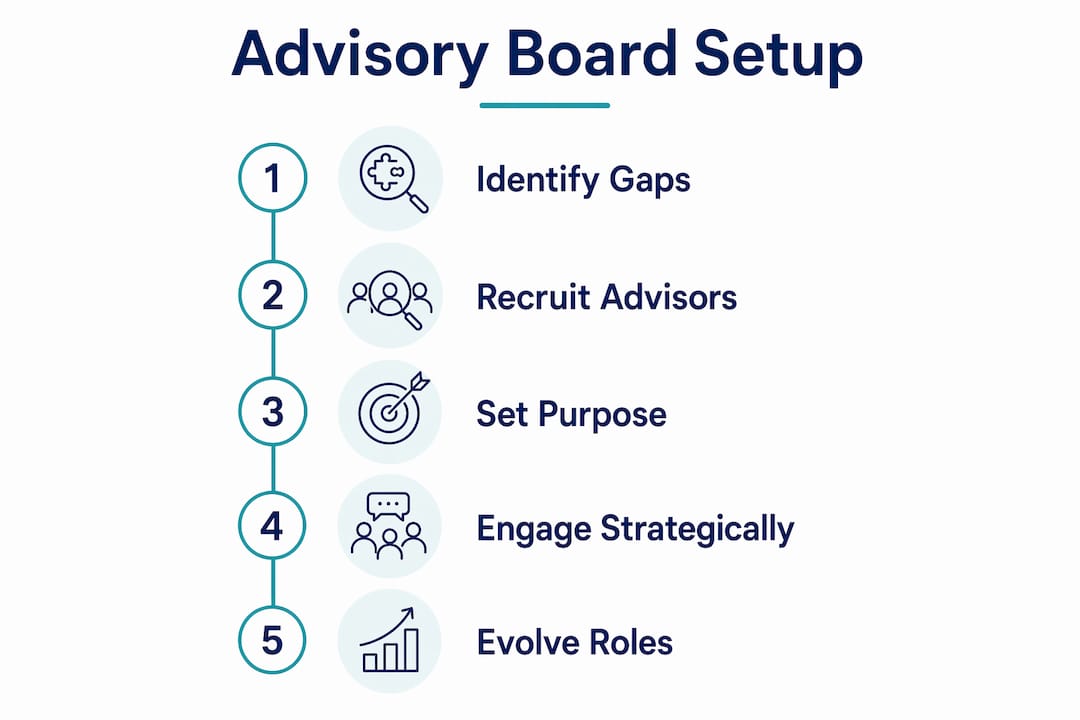
Rigid quarterly meetings are often a sign that an advisory board lacks strategic focus. Project-based engagement, where advisors are pulled in when a specific clinical question needs answering, produces better results for most early-stage startups. The exception is regulatory advisors, who benefit from scheduled check-ins tied to submission timelines.
The single most important structural decision you can make is appointing an internal point person. A fractional Chief Medical Officer is the right person to translate clinical advice into product sprints and business decisions. Without that translator role, advisor input tends to sit in meeting notes and never reach the engineering or commercial teams who need to act on it.
Common pitfalls in advisory engagement include:
- Advisory fatigue: Advisors who are asked to review too many documents or attend too many calls disengage within six months. Protect their time by batching requests.
- Unclear expectations: Advisors who do not know what success looks like stop contributing. Send a one-page engagement brief at the start of each quarter.
- Clinical-to-startup translation failure: Physicians speak in clinical outcomes. Engineers speak in features. Without a translator, both sides talk past each other.
- No feedback loop: Advisors who never see how their input shaped a product decision stop believing their time matters. Close the loop every time.
Pro Tip: Structure every advisory meeting agenda around one or two specific decisions your team needs to make in the next 30 days. Replace general updates with direct questions: “Should we prioritize FHIR integration or EHR-agnostic data export for our first hospital pilot?” That specificity turns a status call into a working session.
What are the common challenges in scaling a medical advisory board?
The most persistent misconception founders carry is that advisors and board directors are interchangeable. Advisory boards carry no fiduciary duties, while boards of directors hold legal liability and binding decision power. Conflating the two creates governance confusion that institutional investors will flag during due diligence.
Important: Never grant advisory board members board observer rights or include them in board meeting minutes without explicit legal review. Doing so can blur the fiduciary line and create unintended liability exposure for your company.
Advisory board composition should evolve as your startup matures. At the seed stage, you need clinical validators who can speak to product-market fit. At Series A, you need advisors with health system relationships and payer experience. By Series B, you may need advisors who can support regulatory submissions or international expansion. Keeping the same five advisors from your pre-seed round through Series B is a common mistake.
| Growth stage | Primary advisor profile | Key advisory focus |
|---|---|---|
| Pre-seed | Practicing clinicians in target specialty | Clinical workflow validation |
| Seed | Physician entrepreneurs and clinical researchers | Product-market fit and pilot design |
| Series A | Health system executives and payer leaders | Enterprise sales and contract navigation |
| Series B and beyond | Regulatory experts and KOLs | FDA pathways, reimbursement, and market expansion |
Equity dilution concerns also surface as startups grow. Advisors recruited at pre-seed with 1.0% grants can become a sensitive topic by Series A when the cap table tightens. Address this proactively by setting shorter vesting windows for later-stage advisors and using cash compensation more frequently as the company scales.
How do medical advisory boards drive investor readiness and startup success?
Startups that use clinical advisors with genuine domain knowledge improve product development efficiency by up to 30% and secure partnerships faster. That figure reflects what happens when clinical input is built into the product cycle rather than bolted on after launch. Investors notice the difference immediately.
A well-structured advisory board signals three things to investors. First, it shows the founding team knows what it does not know. Second, it demonstrates that clinical validation is happening in real time, not as an afterthought. Third, it provides a network of credible references who can vouch for the product’s clinical logic.
Medical advisors also accelerate enterprise sales. A hospital CMO is far more likely to take a meeting when a respected colleague is on your advisory board. That warm introduction compresses a sales cycle that might otherwise take 18 months. The same dynamic applies to payer conversations, where a physician advisor with value-based care experience can translate your product’s outcomes data into language a medical director understands.
Advisory boards built on substantive expertise meaningfully shape product direction and governance. The ones that pass investor scrutiny are not credential lists. They are working groups of people who have changed product decisions, opened doors, and helped the company avoid costly clinical missteps.
Key Takeaways
A medical advisory board is the most cost-effective clinical asset a healthcare startup can build, provided it is structured with clear purpose, appropriate compensation, and active engagement from day one.
| Point | Details |
|---|---|
| Define purpose before recruiting | Identify your top three clinical gaps before approaching any advisor candidate. |
| Use the 2:1 expert-to-rising-star ratio | Combine senior credibility with digitally fluent advisors who engage actively and long-term. |
| Compensate with standard equity terms | Offer 0.25%–1.0% equity with a 2-year vest and 3-month cliff as the baseline structure. |
| Appoint a fractional CMO as translator | A fractional Chief Medical Officer converts clinical advice into product and business decisions. |
| Evolve the board by growth stage | Rotate advisor profiles from clinical validators at seed to regulatory experts at Series B. |
What I have learned about advisory boards after 25 years in healthcare
Most founders I work with make the same mistake. They recruit the most impressive physician they can find, announce it in a press release, and then never speak to that person again. The advisory board becomes a credential list rather than a working asset. I have seen this pattern at companies ranging from early-stage digital health tools to venture-backed population health platforms.
The advisory boards that actually move the needle share one trait: the founder treats advisors like colleagues, not ornaments. At CareGem Health, where I served as an advisor before the company was acquired by Althea.AI within three months, the founding team came to every conversation with a specific clinical question and left with a specific answer. That discipline is rare and it is the reason the company moved so fast.
My honest recommendation is to start smaller than you think you need to. Two deeply engaged advisors who respond to your messages and challenge your clinical assumptions are worth more than ten names on a website. Build the engagement model first. Prove it works with two people. Then scale the board when you have the internal capacity to manage it well.
If you are unsure where to start, the question to ask yourself is simple: what is the one clinical decision standing between your product and your next milestone? The answer tells you exactly what kind of advisor you need to find.
— Paul
Advisory and fractional CMO services from Thestartupmd
Building a medical advisory board is one part of a larger clinical leadership picture. Founders who get the most from their advisors usually have someone internally who can manage those relationships, translate clinical input into product decisions, and represent the company’s medical credibility to investors and health system partners.
Thestartupmd offers fractional CMO and advisory services built specifically for healthcare startups at the seed through Series A stage. Paul Bergeron, MD, MBA brings 25 years of clinical practice, C-suite leadership, and hands-on startup advisory experience to every engagement. Whether you need help structuring your advisory board, preparing for an enterprise sales conversation, or building the clinical governance framework investors expect, Thestartupmd provides the medical voice your startup needs to open doors and grow. Visit Thestartupmd to learn more about how these services work.
FAQ
What is a medical advisory board in a healthcare startup?
A medical advisory board is a group of clinical experts who provide non-binding guidance on product development, clinical validation, and market strategy. Unlike a board of directors, advisors carry no fiduciary duty or legal liability.
How many advisors should a healthcare startup recruit first?
Start with three to five advisors. That number covers key clinical and regulatory gaps without creating coordination overhead that early-stage teams cannot manage.
What is the standard equity compensation for a startup medical advisor?
Standard advisor equity ranges from 0.25% to 1.0%, structured with a 2-year vesting period and a 3-month cliff. Regulatory specialists with rare expertise typically receive the higher end of that range.
How often should a healthcare startup meet with its medical advisors?
Flexible, project-based engagement outperforms rigid quarterly meetings for most startups. Pull advisors in when a specific clinical decision needs input rather than scheduling standing calls.
How does a medical advisory board help with fundraising?
A well-structured advisory board signals to investors that clinical validation is active, the founding team recognizes its expertise gaps, and the company has credible medical references who can vouch for the product’s clinical logic.
Recommended
- Start Up MD – The Startup MD specializes in elevating small to mid-size healthcare startups by offering a comprehensive suite of services, including an integrated digital marketing strategy with targeted lead generation, engaging content creation (long and short-form videos), and custom website design.
- services – Start Up MD
- Home – Copy – Start Up MD