
Patient engagement technology is defined as the set of digital tools and systems that enable patients to actively participate in their own healthcare, rather than receiving care passively. The industry term for this category is “digital health engagement,” and it spans patient portals, mobile health apps, secure messaging platforms, remote patient monitoring devices, and AI-driven outreach tools. Telemonitoring paired with active management can raise blood pressure control rates from approximately 53% to 72%. That single statistic captures why health systems and digital health companies are investing heavily in this space. When patients stay connected to their care teams between visits, clinical outcomes measurably improve.
What is patient engagement technology and how does it work?
Patient engagement technology is not a single product. It is an ecosystem of workflows that includes portals, messaging, patient education, and remote monitoring, all integrated into clinical care. Each tool plays a distinct role, and the value comes from how they work together rather than from any one component in isolation.
The core categories include:
- Patient portals: Web-based platforms where patients access records, request refills, and message care teams.
- Mobile health apps: Smartphone applications that support medication reminders, symptom tracking, and health education.
- Automated and secure messaging: SMS and in-app notifications that deliver appointment reminders, care instructions, and follow-up prompts.
- Telehealth platforms: Video and asynchronous visit tools that extend clinical access beyond the physical office.
- Remote patient monitoring (RPM): Connected devices such as blood pressure cuffs and glucometers that transmit real-time data to clinical teams.
- AI-driven orchestration: Algorithms that identify patients at risk of no-shows or care lapses and personalize outreach timing and channel.
Effective platforms integrate with electronic health records (EHRs) and support billing workflows for Chronic Care Management (CCM) and Transitional Care Management (TCM). Compliance with HIPAA and SOC 2 standards is not optional. It is a baseline requirement for any solution entering a clinical environment.
The distinction between active and passive engagement matters here. Passive engagement means a patient logs into a portal when they choose. Active engagement means the system proactively reaches patients through channels they already use, such as SMS, before a care gap widens. The difference in outcomes between these two models is significant.

Pro Tip: When evaluating any patient engagement platform, ask the vendor how the system initiates contact with patients who have not logged in within 30 days. Passive-only systems leave the most at-risk patients unreached.
What evidence supports the impact of patient engagement technology?
The clinical and operational evidence for digital health engagement is growing, though not uniformly strong. A systematic review found that 61% of digital patient engagement interventions report positive outcomes. The same review noted that many studies carry low methodological quality, which means healthcare executives should evaluate vendor claims against peer-reviewed evidence rather than marketing benchmarks alone.
The operational gains are more consistently documented. Healthcare organizations using AI-integrated engagement platforms achieved a 15% increase in first-time appointments and eliminated double booking. That kind of scheduling efficiency directly reduces administrative burden and improves patient access without adding clinical staff.
“Patient engagement is primarily about driving behavior change and clinical outcomes, not just increasing digital adoption metrics or marketing KPIs. The measure of success is whether patients are healthier, not whether they downloaded an app.”
The table below summarizes key evidence categories and their practical implications for health system leaders.
| Evidence Category | Finding | Implication |
|---|---|---|
| Blood pressure control | Control rates rose from 53% to 72% with telemonitoring | RPM with clinical follow-up delivers measurable outcomes |
| Appointment access | 15%+ increase in first-time appointments via AI scheduling | AI automation improves access without adding staff |
| Intervention efficacy | 61% of digital interventions show positive outcomes | Evidence supports adoption, but rigor varies by study |
| Operational efficiency | Reduced administrative burden and double booking | Engagement tech creates financial and workflow returns |
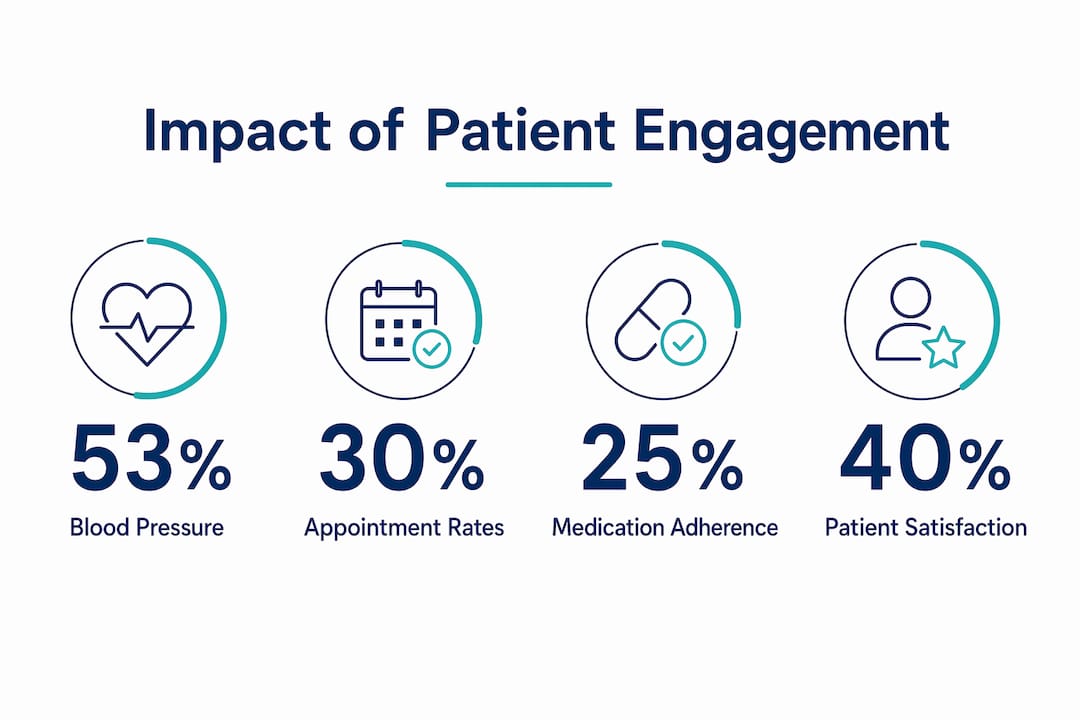
The pattern across these findings is consistent. Technology alone does not produce results. Connected devices paired with timely clinical follow-up outperform software-only deployments in every documented category.
What are common challenges when implementing patient engagement technology?
Most engagement initiatives fail not because the technology is wrong but because the implementation ignores patient burden. When organizations require patients to download an app, create an account, pair a Bluetooth device, and then wait days for a clinical response, adoption collapses. Minimizing patient setup requirements and building in clinical escalation pathways from the start are the two most important design decisions an organization can make.
The four most common implementation failures follow a predictable pattern:
- Requiring too many patient steps at onboarding. Every additional action a patient must take before receiving value reduces adoption. Devices should work out of the box. Enrollment should take under three minutes.
- Choosing a passive-only channel strategy. Waiting for patients to log into a portal is not a strategy. Organizations must use SMS as a trigger channel that routes patients to deeper interactions only when needed.
- Failing to close the clinical feedback loop. Patients who submit data and receive no response disengage within weeks. Clinical staff must have clear protocols for responding to alerts and readings.
- Misaligning technology with staffing and workflows. A platform built for a large health system will not fit a 10-physician practice without significant reconfiguration. Matching the tool to the team is not a technical decision. It is a clinical strategy decision.
Pro Tip: Before selecting a platform, map your current patient communication workflows and identify where patients fall out of contact. The right technology fills those specific gaps rather than replacing what already works.
Workflow alignment also means timing content correctly. A post-discharge education message sent three days after a patient leaves the hospital lands differently than one sent within 24 hours. The clinical messaging framework your organization uses should define timing, channel, and escalation criteria for each patient population.
How can healthcare professionals apply patient engagement technology effectively?
Selecting and deploying patient engagement tools requires a structured approach that goes beyond comparing feature lists. Healthcare executives need to define measurable use cases first, then evaluate technology against those specific goals. Treating engagement as a care model innovation rather than a software purchase changes how organizations evaluate, implement, and measure these tools.
Practical criteria for technology selection include:
- EHR integration depth: Does the platform write data back to the chart, or does it create a separate data silo?
- Billing code support: Does it support CCM, TCM, and Remote Physiologic Monitoring (RPM) billing to generate revenue that offsets the platform cost?
- HIPAA and SOC 2 compliance: Are audit logs, data encryption, and business associate agreements standard, not add-ons?
- AI-assisted routing: Can the system identify patients at risk of disengagement and trigger personalized outreach automatically?
- Channel flexibility: Does the platform support SMS, email, in-app messaging, and voice, with patient-level channel preferences?
Measuring success requires going beyond patient satisfaction scores. The metrics that matter are clinical: hemoglobin A1c reduction, blood pressure control rates, 30-day readmission rates, and care gap closure. Operational metrics like appointment show rates and staff time per patient contact complete the picture.
AI orchestration behind engagement platforms can identify patients at risk of no-shows or care lapses and personalize interventions at scale. This capability is particularly valuable for ACOs and value-based care organizations managing large attributed populations where manual outreach is not feasible.
Key Takeaways
Patient engagement technology delivers measurable clinical and operational results only when connected devices, proactive outreach, and clinical follow-up work together as an integrated system.
| Point | Details |
|---|---|
| Definition matters | Patient engagement technology is an ecosystem of tools, not a single product. |
| Evidence is real but uneven | 61% of digital interventions show positive outcomes; evaluate vendor claims against peer-reviewed data. |
| Patient burden kills adoption | Minimize setup steps and build clinical escalation pathways into every deployment. |
| Proactive outreach wins | SMS-triggered, channel-preferred outreach outperforms passive portal-only strategies. |
| Measure clinical outcomes | Track blood pressure control, readmissions, and care gap closure, not just app downloads. |
What I’ve learned about patient engagement technology after 25 years in clinical practice
The vendors will tell you their platform drives engagement. What they often mean is that it drives logins. Those are not the same thing.
I’ve worked with health systems, ACOs, and digital health startups across more than two decades, and the pattern is consistent. Organizations that see real clinical gains from engagement technology share one trait: they treat it as a clinical program, not an IT deployment. They assign ownership, define protocols, train staff, and review outcomes quarterly. The technology is the infrastructure. The clinical team is the engine.
The most underrated factor in any engagement program is the speed of clinical response. A patient who submits a blood pressure reading of 160/100 and hears nothing for 48 hours will not submit another reading. The feedback loop is everything. No AI model or automated reminder fixes a broken response protocol.
I’m also watching the AI orchestration layer closely. The ability to identify which patients are drifting from care before they miss an appointment or skip a medication is genuinely powerful. But it requires clean data, EHR integration, and staff who act on the alerts. The technology surfaces the signal. Humans still have to respond to it.
Healthcare leaders should be skeptical of any vendor claiming universal results. Realized gains depend heavily on clinical specialty, staffing ratios, and existing workflows. The right question to ask any vendor is not “what outcomes have you achieved?” It is “what outcomes have organizations like mine achieved, and what did they have to change to get there?”
— Paul
How Thestartupmd supports healthcare organizations with patient engagement strategy
Healthcare organizations building or refining a patient engagement program often know what outcomes they want. The harder question is how to get there without wasting time on technology that does not fit their clinical model.
Thestartupmd works with health systems, physician practices, and digital health companies to develop patient engagement services that align technology selection with clinical workflows, staffing realities, and billing strategy. Paul Bergeron, MD, MBA brings 25 years of clinical and executive experience to every engagement, including leading ACOs serving 375,000+ covered lives and generating $17.2M in Medicare Shared Savings. If your organization is evaluating patient engagement tools or needs a clinical voice to guide implementation, Thestartupmd offers the strategic depth to move from selection to measurable outcomes.
FAQ
What is patient engagement technology in simple terms?
Patient engagement technology is the set of digital tools that help patients stay actively involved in their care between clinical visits. It includes patient portals, mobile apps, remote monitoring devices, secure messaging, and automated outreach systems.
What are the main benefits of patient engagement technology?
The primary benefits include improved clinical outcomes such as better blood pressure control, higher appointment rates, reduced administrative burden, and earlier identification of care gaps. These gains depend on combining technology with timely clinical follow-up.
How does remote patient monitoring differ from a patient portal?
A patient portal is a passive tool that patients access when they choose. Remote patient monitoring uses connected devices to transmit real-time health data to clinical teams, enabling proactive intervention rather than waiting for a scheduled visit.
What compliance standards apply to patient engagement platforms?
HIPAA and SOC 2 compliance are the baseline requirements for any patient engagement platform operating in a U.S. clinical environment. Platforms should also support EHR integration and billing codes for CCM, TCM, and RPM to fit clinical and financial workflows.
How do you measure the success of a patient engagement program?
Success is measured through clinical outcomes such as hemoglobin A1c levels, blood pressure control rates, and 30-day readmission rates, not just digital adoption metrics like app downloads or portal logins.