
A clinical content strategy in healthtech is defined as a regulated operating model that creates, reviews, distributes, and measures content to drive clinical credibility and commercial adoption simultaneously. This is not generic SEO with medical terms added. It is a multi-stakeholder trust system that functions as an education engine, a compliance exercise, and commercial infrastructure at the same time. Healthcare executives and policymakers who treat it as a simple marketing function consistently underperform on both regulatory and revenue metrics. The frameworks that work integrate FDA, HIPAA, and MDR requirements from day one, not as afterthoughts.
What is clinical content strategy in healthtech?
A clinical content strategy in healthtech is the operating model that aligns evidence-based messaging with business goals, payer expectations, and patient needs inside a regulated environment. The industry term for the broader practice is healthcare content marketing, but the healthtech version carries a compliance burden that standard content marketing does not. Every asset, from a white paper to a product landing page, must survive medical, legal, and regulatory review before it reaches a clinical audience.
The gap between generic content marketing and a true clinical strategy shows up fast. A health system CMO reading a product brief expects clinical evidence, not brand voice. A payer reviewing a coverage dossier expects outcome durability data, not testimonials. A compliance officer reviewing a campaign expects documented approval workflows, not a shared Google Doc. Meeting all three audiences with the same content system requires architecture, not improvisation.
Thestartupmd works with healthtech companies that discover this gap after their first enterprise sales cycle fails. The fix is not better writing. The fix is a structured operating model built around clinical credibility.

What are the key components of a clinical content strategy in healthtech?
Five components make up a complete clinical content strategy. Missing any one of them weakens the entire system.
- Audience segmentation. Clinical and administrative roles require different messages. A hospitalist, a procurement director, and a population health manager each evaluate your product through a different lens. Segmentation maps those lenses before any content is written.
- Pillar–cluster content architecture. A pillar page anchors the core clinical claim. Cluster content supports it with evidence, use cases, and FAQs. This structure organizes your evidence base and signals topical authority to both search engines and clinical reviewers.
- MLR-ready workflow. Medical, legal, and regulatory review is not a final checkpoint. It is a design constraint. Content built outside an MLR workflow gets rewritten or killed before it reaches the audience.
- Distribution across clinical touchpoints. Peer-reviewed journals, clinical newsletters, conference presentations, and digital channels each carry different credibility weights with different audiences. A distribution plan maps which channel reaches which stakeholder.
- Measurement beyond traffic. Page views do not measure clinical adoption. Metrics that matter include compliance approval rate, content production cycle time, and evidence-to-claim traceability.
Pro Tip: Build your measurement dashboard before you write your first piece of content. If you cannot measure compliance adherence and production efficiency from day one, you are flying blind in a regulated environment.
| Metric category | What to track |
|---|---|
| Compliance | MLR approval rate, revision cycles, PHI exposure incidents |
| Production | Time from brief to approval, rework rate per asset |
| Clinical impact | Evidence citation rate, payer dossier acceptance, HCP engagement |
| Commercial | Pipeline influenced, enterprise deal velocity, coverage decisions |
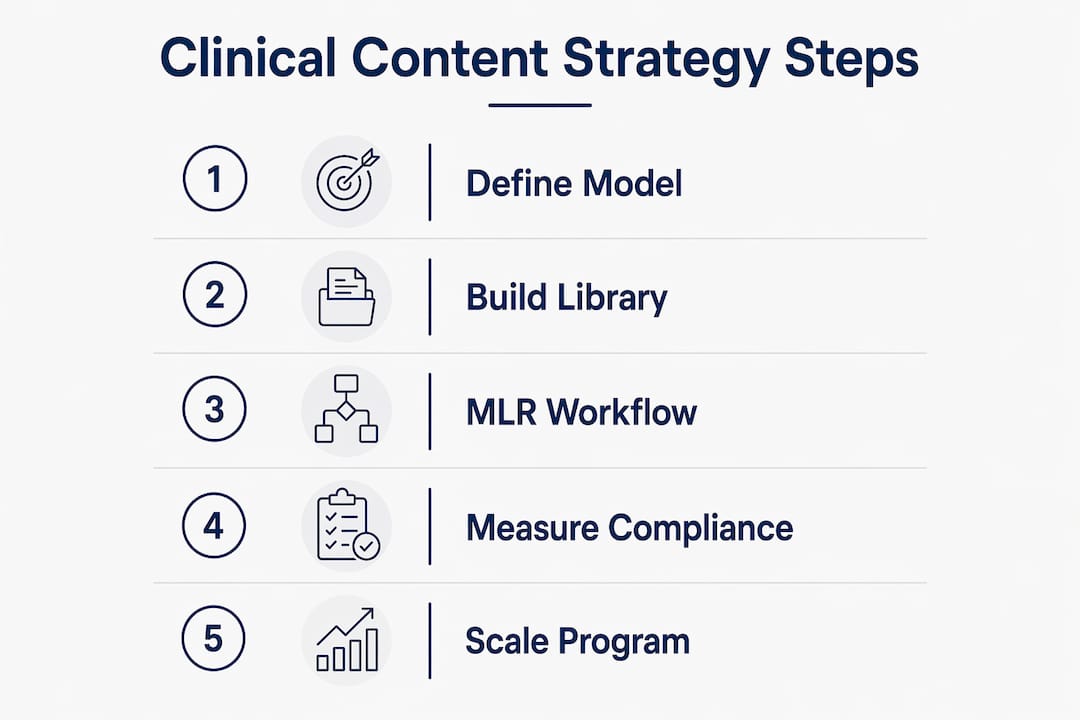
How to maintain compliance and mitigate risks in clinical content messaging
Compliance failures in healthtech content rarely come from bad writing. They come from broken processes. The three regulatory frameworks that govern clinical content are FDA promotional guidelines, HIPAA marketing rules, and MDR Article 61 for medical devices sold in European markets.
HIPAA is the most misunderstood. HIPAA requires authorization for any marketing-related use or disclosure of protected health information, with narrow exceptions for face-to-face encounters and nominal promotional gifts. That means your CRM segmentation, your email targeting logic, and your retargeting pixels all carry HIPAA risk, not just your copy. Compliance failures frequently originate in channel and data mechanics, not in the final editorial copy.
MDR Article 61 requires clinical evaluation planning and reporting as part of CE marking for medical devices. Clinical evaluation reports become part of the technical documentation package. Content teams that ignore this pathway create messaging that contradicts the regulatory record, which creates liability.
A practical compliance framework for healthtech content teams includes these steps:
- Define your claims taxonomy. Categorize every claim as clinical, economic, or operational. Each category carries different evidence requirements and review thresholds.
- Build an MLR routing matrix. Map which claim categories trigger which reviewers. Not every asset needs full legal review. Routing rules save time without sacrificing rigor.
- Implement a PHI firewall in your data stack. Audit your marketing automation, CRM, and analytics tools for PHI exposure before launching any campaign.
- Document every approval. Maintain a version-controlled approval log for every published asset. Regulators and enterprise procurement teams both ask for this.
- Run a narrative drift audit quarterly. Compare live content against your approved claims library. Drift happens silently as teams update pages without triggering review.
Pro Tip: Treat your HIPAA marketing compliance review as a data governance audit, not an editorial one. The risk lives in your tech stack as much as in your messaging.
Why does early technology review matter for evidence-driven content?
Early Technology Review, or ETR, is the practice of engaging payers, clinical experts, and health economists before a product reaches market, specifically to align evidence generation with coverage and adoption requirements. ETR integrates target population definition, outcome durability, comparator relevance, and economic benefit analysis at the prototype and proof-of-concept stages. That is far earlier than most healthtech teams think about content.
The content implication is direct. If your ETR reveals that payers require two-year outcome data to consider coverage, your content strategy must sequence evidence publication to support that timeline. White papers, clinical briefs, and conference abstracts all need to build toward that evidence milestone, not run ahead of it.
“Healthtech teams consistently underestimate how early payer and clinical expert expectations shape what counts as credible evidence. Content built without ETR input often contradicts the evidence base the product actually needs to win coverage.”
ETR also defines your comparator landscape. Payers do not evaluate your product in isolation. They compare it against the current standard of care and against competing technologies. Your content must address those comparators directly, with evidence, not with positioning language. A content strategy built on ETR findings is more credible to clinical audiences and more defensible in regulatory review.
- ETR findings define which outcome measures your content must reference
- Comparator data from ETR shapes your clinical differentiation narrative
- Economic benefit analysis from ETR feeds your payer-facing value dossiers
- Durability evidence requirements from ETR set your publication timeline
What are best practices for scaling clinical content in healthtech organizations?
Scaling a clinical content program without a governance structure produces volume without compliance. The operational framework that prevents this combines a claims library, an evidence registry, and routing rules into a single source of truth for all stakeholder-facing content.
A claims library paired with an evidence registry ensures that every asset draws from the same validated factual base. This reduces rework, prevents expensive narrative drift, and gives your MLR team a consistent reference point. Routing rules determine which claims require which level of review before publication.
Role-specific messaging generated from a single approved positioning spine is the practical solution to narrative drift. You write one core clinical claim, then generate variants for clinicians, administrators, and payers from that same approved foundation. Each variant stays within the bounds of the reviewed claim. None of them require a full re-review from scratch.
| Approach | Without governance | With claims library |
|---|---|---|
| Message consistency | Varies by writer and channel | Uniform across all stakeholders |
| MLR cycle time | Unpredictable, often long | Shorter due to pre-approved claims |
| Narrative drift risk | High, especially across teams | Low, controlled by routing rules |
| Rework rate | Frequent | Minimal |
AI-assisted drafting fits inside this framework when it is constrained by the claims library. AI tools generate role variants faster than human writers. The governance layer, not the AI tool, is what keeps those variants compliant. Cross-functional collaboration between marketing, clinical, regulatory, and data governance teams is not optional in this model. It is the operating condition.
- Assign a clinical content owner who sits at the intersection of marketing and medical affairs
- Run monthly claims library audits to retire outdated evidence and add new approvals
- Use workflow automation to trigger MLR routing when new assets enter the production queue
- Track production efficiency metrics alongside compliance metrics in a shared dashboard
Key takeaways
A clinical content strategy in healthtech requires five integrated components: audience segmentation, pillar-cluster architecture, MLR-ready workflows, targeted distribution, and compliance-focused measurement.
| Point | Details |
|---|---|
| Define the operating model first | Build your claims library and MLR workflow before producing any content assets. |
| HIPAA risk lives in your data stack | Audit your CRM, automation tools, and analytics for PHI exposure, not just your copy. |
| ETR shapes your evidence timeline | Engage payers and clinical experts early to align content sequencing with coverage requirements. |
| Narrative drift is a process failure | A positioning spine with role-specific variants prevents inconsistent messaging across stakeholder groups. |
| Measure compliance, not just traffic | Track MLR approval rates, production cycle time, and evidence-to-claim traceability alongside engagement metrics. |
What I have learned building clinical content programs from the inside
The most common mistake I see healthtech companies make is treating clinical content as a marketing deliverable rather than a regulated product. I have worked with teams that had excellent writers, strong clinical advisors, and real evidence. They still failed enterprise sales cycles because their content could not survive procurement review. The problem was never the quality of the writing. The problem was the absence of a governance structure.
The claims library concept sounds bureaucratic until you watch a team spend three weeks in MLR review because one writer used an unapproved efficacy claim in a blog post. A controlled claims library with routing rules turns that three-week cycle into three days. That is not a compliance win. That is a commercial win.
HIPAA compliance in content is the area I see most underestimated. Executives focus on the copy. The real exposure is in the data layer. Your email platform, your CRM segmentation logic, and your website analytics can all create PHI liability before a single word is written. I always start a content governance engagement by auditing the tech stack, not the content calendar.
Early stakeholder engagement, specifically ETR-style payer and clinical expert input, is the single highest-leverage investment a healthtech company can make in its content program. The teams that do this early build content that opens doors. The teams that skip it build content that sounds good internally and falls flat externally. If you are building a healthtech company and your content team has never spoken directly with a payer medical director, that conversation needs to happen before your next content sprint.
— Paul
How Thestartupmd supports healthtech content strategy execution
Clinical content strategy requires physician-level credibility, regulatory fluency, and commercial execution working together. Most healthtech companies have one or two of those. Rarely all three.
Thestartupmd brings all three to early-stage and growth-stage healthtech companies through fractional CMO services and hands-on content strategy consulting. The work includes building claims libraries, designing MLR-ready workflows, aligning evidence generation with payer expectations, and creating role-specific messaging that survives enterprise procurement review. For companies ready to move from content production to content governance, the full services portfolio covers digital marketing, lead generation, clinical content development, and regulatory-aligned go-to-market strategy.
FAQ
What is a clinical content strategy in healthtech?
A clinical content strategy in healthtech is a regulated operating model that creates, reviews, distributes, and measures content to build clinical credibility and drive commercial adoption. It integrates audience segmentation, evidence-based messaging, MLR workflows, and compliance governance into a single system.
How does HIPAA affect healthtech content marketing?
HIPAA requires prior patient authorization for any marketing use of protected health information, with narrow exceptions. Compliance risk lives in your data and channel infrastructure, not just in the copy itself.
What is an MLR workflow in clinical content?
An MLR workflow is a structured medical, legal, and regulatory review process that every content asset must pass before publication. It routes claims by category to the appropriate reviewers and documents approvals for regulatory and procurement accountability.
Why does early technology review matter for content strategy?
ETR aligns your evidence generation with payer and clinical expert expectations before your product reaches market. Content built on ETR findings sequences evidence publication to support coverage decisions and clinical adoption timelines.
How do you prevent narrative drift in healthtech content?
Narrative drift is controlled by building a single approved positioning spine and generating role-specific variants from a controlled claims library within the same MLR review workflow. Quarterly audits of live content against the approved claims base catch drift before it creates compliance exposure.
Recommended
- Home – Copy – Start Up MD
- Start Up MD – The Startup MD specializes in elevating small to mid-size healthcare startups by offering a comprehensive suite of services, including an integrated digital marketing strategy with targeted lead generation, engaging content creation (long and short-form videos), and custom website design.
- services – Start Up MD