
Care model innovation is the process by which healthcare startups redesign patient care delivery using technology and new operational strategies to improve outcomes and reduce costs. This is not a fringe concept. It is the defining competitive advantage separating funded, scalable startups from those that stall. Care model innovation explained across startups in 2026 centers on three forces: AI integration into clinical workflows, a hard shift toward outcome-based payment, and the operational discipline to make both work at scale. Entrepreneurs who understand these forces build companies that attract capital and win contracts. Those who miss them build tools that health systems never buy.
What are the key components of care model innovation in startups?
Care model innovation, known in clinical strategy circles as care delivery redesign, restructures who deliver care, how it is coordinated, and how it is paid for. The components are not optional add-ons. They are the architecture of the model itself.
Technology integration is the first pillar. AI agents now manage patient journey tasks that once required full-time staff. Assort Health reported a 115% increase in labor capacity by deploying AI across patient scheduling, triage, and follow-up. That figure means one clinical team can serve twice the patient volume without adding headcount.

Care coordination is the second pillar. Startups like Hera deploy AI-powered care experts, called Heroes, to manage non-clinical tasks for senior patients between doctor visits. Hera serves over 1,000 families with a 95% retention rate. Retention at that level signals that patients find genuine value, not just novelty.
Virtual-first and hybrid delivery rounds out the model. Virtual pediatric therapy, remote chronic disease management, and AI-assisted home health each represent architectural shifts in where and how care happens. These are not incremental improvements to existing workflows. They are structural replacements.
The types of innovation matter too:
- Disruptive innovation replaces existing care settings entirely, such as home-based primary care replacing clinic visits for frail elderly patients.
- Incremental innovation improves existing workflows, such as adding AI scheduling to a traditional practice.
- Architectural innovation recombines existing components in new ways, such as pairing remote monitoring with community health workers under a single care plan.
Pro Tip: Start with architectural innovation. It requires less regulatory navigation than disruptive models and produces measurable outcomes faster, giving you the data you need to raise your next round.
How are emerging payment models influencing care model innovation?
Payment model innovation drives care model innovation. Startups that ignore reimbursement design build clinically sound models that cannot survive financially.
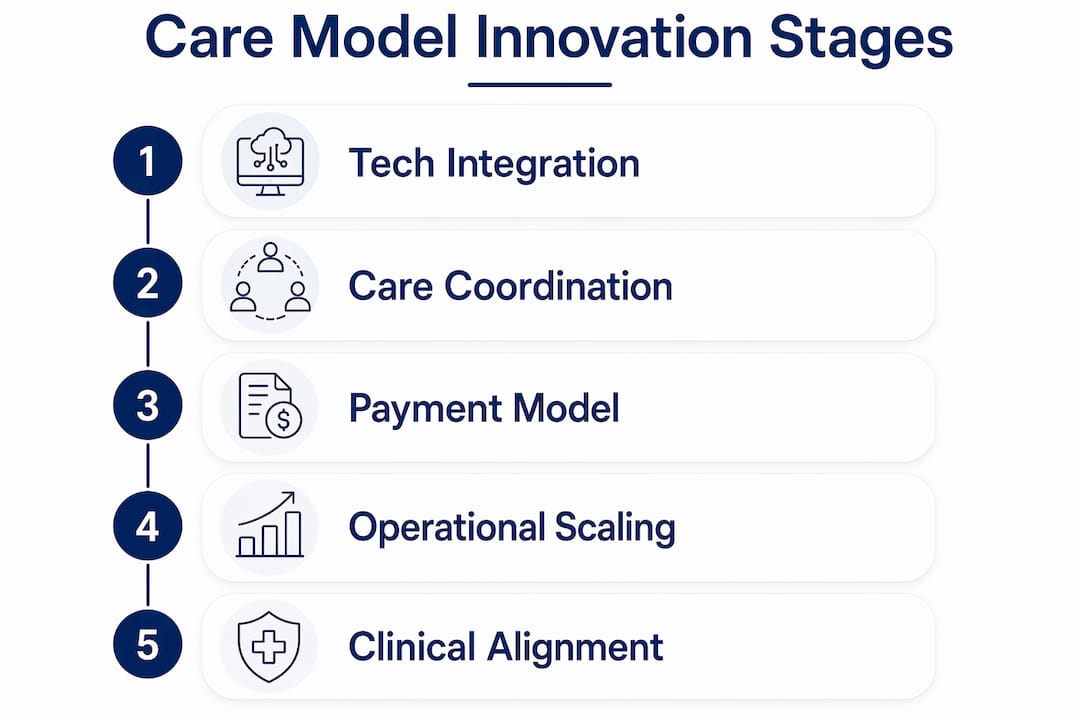
The shift from fee-for-service to outcome-based payment is now a federal priority. CMS launched its 10-year ACCESS program in 2026 with $10 billion in funding to test AI-driven care delivery tied to outcomes rather than visit volume. That is a structural signal, not a pilot. Startups that align their care models to outcome metrics now will have a significant contracting advantage as ACCESS scales.
The practical path for most startups is a hybrid model. Pure value-based care requires patient volume and risk tolerance that early-stage companies rarely have. Pure fee-for-service rewards activity, not outcomes, and attracts the wrong payer mix. Ennoble Care uses a hybrid approach that combines CMS’s Medicare Shared Savings Program with traditional fee-for-service markets. This gives the company revenue stability while building the outcomes data needed to deepen value-based contracts over time.
The Medicare Shared Savings Program itself remains a proven ground. Thestartupmd’s founder, Paul Bergeron, MD, MBA, earned $17.2M in Medicare Shared Savings while leading ACOs serving 375,000+ covered lives. That experience makes the case clearly: outcome-based models pay, but only when clinical operations are tight enough to hit quality benchmarks.
Here is the sequence most successful startups follow when building their payment strategy:
- Launch with a cash-pay pilot to validate willingness to pay and product-market fit without insurance contracting delays.
- Layer in fee-for-service billing once clinical workflows are stable and documentation is clean.
- Pursue value-based contracts, starting with MSSP or direct employer contracts, once outcomes data is available.
- Seek CMS innovation program participation, such as ACCESS, once the model is proven at meaningful scale.
Cash-pay pilot phases represent roughly 1% of a startup’s potential market but deliver the fastest and cleanest market signals. That tradeoff is worth it. Clean data beats fast growth when you are trying to close your Series A.
What operational strategies do startups use to scale innovative care models?
Operational execution separates funded care model concepts from companies that actually deliver care. Three strategies define the startups that scale.
Becoming the provider, not just the vendor
Investors and clinical advisors consistently identify a critical insight: startups that become direct care providers, rather than selling tools to existing providers, gain far more control over clinical workflows and administrative costs. When you own the care delivery, you control the data, the quality metrics, and the margin. When you sell software to a health system, you depend on their willingness to change behavior.
AI-native home health providers illustrate this clearly. Traditional home health agencies carry high administrative overhead because they rely on manual scheduling, paper-based documentation, and phone-based coordination. AI-native providers cut those costs close to zero, which lets them accept patients that traditional agencies turn away, including complex Medicaid patients and high-cost chronic disease populations. The result is a broader addressable market and a structural cost advantage.
Achieving patient density
Patient density is the operational metric that most early-stage home care startups underestimate. High patient density reduces clinician travel time, increases the number of visits per shift, and directly improves both clinician compensation and company margin. AI platforms that cluster patients geographically before assigning clinicians solve this problem at scale. Without density, home care unit economics rarely work.
Building for interoperability from day one
Legacy system integration is the operational challenge that kills otherwise sound care models. Standards-based, modular architecture allows startups to deploy new care services without disrupting existing clinical workflows in partner health systems. Telstra Health’s Corus platform demonstrates this principle at the enterprise level. Startups that build with HL7 FHIR standards from the start avoid the costly retrofitting that stalls enterprise sales cycles.
Pro Tip: Map your interoperability requirements before you write your first line of code. Enterprise health system buyers will ask about EHR integration in the first meeting. If you cannot answer confidently, the deal stalls.
| Operational strategy | Primary benefit | Key risk if ignored |
|---|---|---|
| Become the care provider | Control over margin and quality data | Dependency on partner behavior |
| Achieve patient density | Lower cost per visit, higher clinician pay | Unprofitable unit economics |
| Build modular, standards-based tech | Faster enterprise integration | Costly retrofits, lost contracts |
| Cash-pay pilot validation | Clean market signal before insurance | Premature scaling on weak data |
What are the primary challenges and success factors for startups innovating care models?
The failure rate in healthcare startups is high, and the reasons are predictable. Understanding them before you hit them is the advantage.
The biggest challenge is the clinical-AI expertise gap. Investors flag this consistently: startups that lack combined clinical and AI engineering expertise under one roof carry significantly higher failure risk. A clinician-only founding team builds models that are medically sound but technically fragile. An engineering-only team builds technically impressive tools that miss clinical workflow realities. The solution is integration, not partnership. Hire both, or find a fractional clinical leader who has operated in both worlds.
Scaling human teams while deploying AI is harder than it looks. AI handles volume. Humans handle exceptions, trust, and the nuanced conversations that determine whether a patient stays engaged. Startups that automate too aggressively lose the human signal that tells them when the model is failing.
Regulatory navigation is a constant drag on speed. State licensure requirements, CMS enrollment timelines, and HIPAA compliance each add months to a go-to-market timeline. Startups that treat regulatory work as a late-stage problem consistently miss their launch windows.
The success factors are equally clear:
- Integrated clinical-AI teams that embed AI into clinical workflows rather than bolting it on as a reporting layer.
- Modular system architecture that allows the startup to add payer types, geographies, or service lines without rebuilding core infrastructure.
- Early market validation through cash-pay pilots that generate outcomes data before the startup enters complex insurance contracting.
- Outcome metrics that match payer priorities, specifically HEDIS measures, readmission rates, and total cost of care, so that value-based contracts are within reach as the company scales.
Key takeaways
Care model innovation succeeds when startups combine AI-enabled operations, outcome-aligned payment structures, and clinical credibility into a single, integrated delivery model.
| Point | Details |
|---|---|
| AI drives operational scale | AI-powered care coordination can more than double labor capacity without adding clinical headcount. |
| Payment model alignment is non-negotiable | Startups must sequence from cash-pay to fee-for-service to value-based contracts as outcomes data matures. |
| Becoming the provider beats selling tools | Direct care delivery gives startups control over margin, quality data, and clinical workflow. |
| Patient density determines unit economics | Geographic clustering of patients reduces travel time and makes home care financially viable. |
| Clinical-AI integration is the core success factor | Startups with combined clinical and engineering expertise internally outperform those that treat AI as external software. |
What I’ve learned about care model innovation after 25 years in the room
Most healthcare entrepreneurs I work with arrive with a strong clinical instinct and a weak payment strategy. Or they arrive with a sharp technology vision and no clinical credibility. Both gaps are fatal, just at different stages of the company’s life.
The startups I have seen succeed share one trait: they treat care model design as a business architecture problem, not a clinical protocol problem. The question is not “what is the best way to care for this patient?” The question is “what is the best way to care for this patient that also generates a margin, scales to 10,000 patients, and satisfies a payer contract?” Those are different questions, and conflating them is where most early-stage teams lose time.
The CMS ACCESS program is the most significant structural signal I have seen in a decade. Ten billion dollars tied to AI-driven outcome metrics is not an experiment. It is a market signal that the federal government is ready to pay for care models that actually work. Startups that position now, before the program matures, will have a contracting advantage that late movers cannot replicate.
The other thing I tell founders directly: get your clinical governance right before you scale. HEDIS performance, quality benchmarks, and outcomes reporting are not compliance exercises. They are the evidence base that wins enterprise contracts and value-based deals. I improved HEDIS performance 29% year over year at Steward Health Care Network by treating quality metrics as a growth strategy, not a reporting burden. That same mindset applies to every startup I advise through Thestartupmd.
If your care model is clinically sound but commercially unclear, that is the gap worth closing now.
— Paul
How Thestartupmd helps startups build and scale care models
Healthcare entrepreneurs building new care models need more than a great clinical concept. They need a go-to-market strategy, a credible medical voice for enterprise sales, and a digital presence that earns trust with health system buyers and investors.
Thestartupmd works directly with healthcare SaaS companies, digital health startups, and care delivery organizations to build the clinical strategy and market presence that accelerates growth. Services include fractional CMO support, clinical product development, enterprise sales enablement, and targeted digital marketing. Paul Bergeron, MD, MBA brings 25+ years of clinical and executive experience to every engagement. Explore the full range of startup support services and find out how Thestartupmd helps care model innovators move from concept to contract.
FAQ
What is care model innovation in healthcare startups?
Care model innovation is the redesign of patient care delivery using technology, new team structures, and alternative payment strategies to improve outcomes and reduce costs. Startups apply this through AI integration, virtual care, and value-based payment models.
How does AI improve care model efficiency for startups?
AI agents automate scheduling, triage, and patient follow-up, freeing clinical staff for higher-complexity tasks. Assort Health reported a 115% increase in labor capacity using AI-powered patient journey management.
What payment models work best for early-stage healthcare startups?
A sequenced approach works best: start with cash-pay pilots to validate the model, then add fee-for-service billing, then pursue value-based contracts as outcomes data accumulates. Hybrid models combining fee-for-service and MSSP participation offer the most sustainable path.
Why do healthcare startups fail at care model innovation?
The most common failure is a mismatch between clinical design and commercial viability. Startups also fail when they lack combined clinical and AI expertise internally, scale before validating product-market fit, or underestimate regulatory timelines.
What is CMS’s ACCESS program and why does it matter for startups?
CMS’s ACCESS program is a 10-year, $10 billion federal initiative launched in 2026 to test AI-driven care delivery tied to health outcomes rather than visit volume. Startups that align their care models to ACCESS metrics now gain a significant advantage in future federal contracting.
Recommended
- Start Up MD – The Startup MD specializes in elevating small to mid-size healthcare startups by offering a comprehensive suite of services, including an integrated digital marketing strategy with targeted lead generation, engaging content creation (long and short-form videos), and custom website design.
- Home – Copy – Start Up MD
- services – Start Up MD